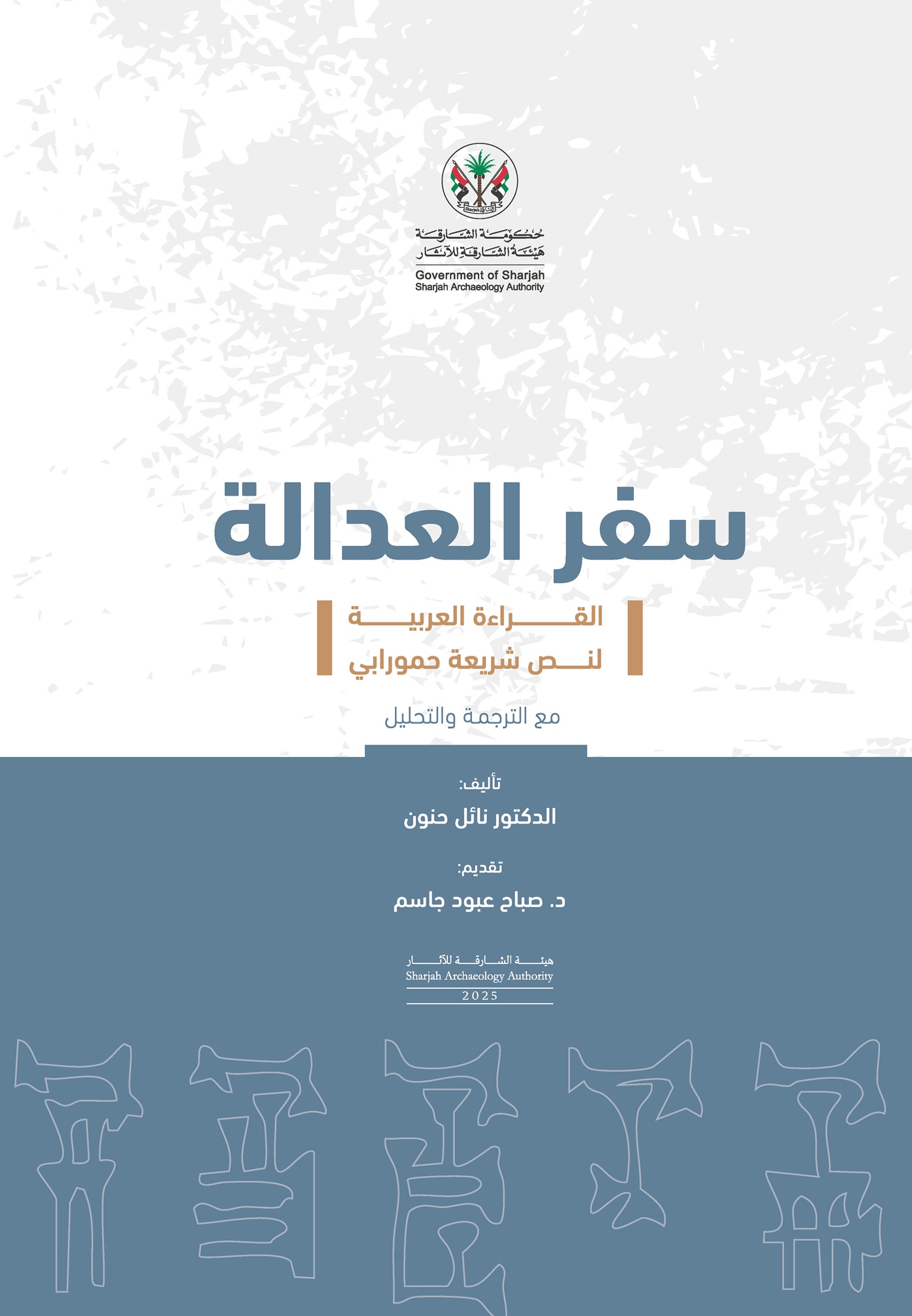
Published Date : 2025
Auther : Dr. Nael Hannoun
Publisher : Sharjah Archaeology Authority
Available Languages -
Hammurabi, king of Babylon (1792–1750 BCE), emerged in a land with a long and rich tradition of legislation spanning centuries, and a pioneering and sophisticated system of justice and law enforcement. Before his ascension to the throne of Babylon (in present-day southern Iraq), archaeological discoveries have revealed one reform code and three sets of laws. Thus, when he issued his code, he was not merely the author of the oldest legal code in history, as is commonly believed today, but rather the author of the oldest complete legal code in human history. The reform code was issued by Urukagina (around 2350 BCE), ruler of Lagash (modern-day Tell el-Hiba in southern Iraq). The three sets of laws were issued by Ur-Nammu (2112–2095 BCE), king of Ur and founder of its third dynasty, or by his son and successor, Shalgi, and the laws of Lipit-Ishtar (around 1930 BCE), king of Ur. Isin (modern-day Ishan Bahriyat in southern Iraq), and finally the laws of the kingdom of Eshnunna (modern-day Tell Asmar in the Diyala region of eastern Iraq) around 1900 BCE. It should be noted here that the use of the term “Code” refers to its role as a source of laws and legal rulings in its time, according to specialists.

“Pre-Islam Coinages In Eastern Arabian Peninsula”
Published Date : 2021
Auther : Daniel T. Potts, Sabah Aboud Jassim
Publisher : Sharjah Archaeology Authority
Available Languages -
The book is written by D.T. Bots; translated and prepared by Dr. Sabah Aboud Jassem. ...

Early Abbasid Era in the Emirate of Sharjah
Published Date : 2022
Auther : Eisa Yousef
Publisher : Sharjah Archaeology Authority
Available Languages -
In the introduction to his book, the author discussed the concept of studying archaeological finds ...